


Manuka Honey Articles · 7 min read
What Strength of Manuka Honey Should I Have? A Guide to UMF™ Ratings
 By Clare
9 Oct 2026
By Clare
9 Oct 2026

Manuka Honey Articles · 7 min read
What Strength of Manuka Honey Should I Have? A Guide to UMF™ Ratings
By Clare
9 Oct 2026

Manuka Honey Articles · 7 min read
What Strength of Manuka Honey Should I Have? A Guide to UMF™ Ratings
By Clare
9 Oct 2026
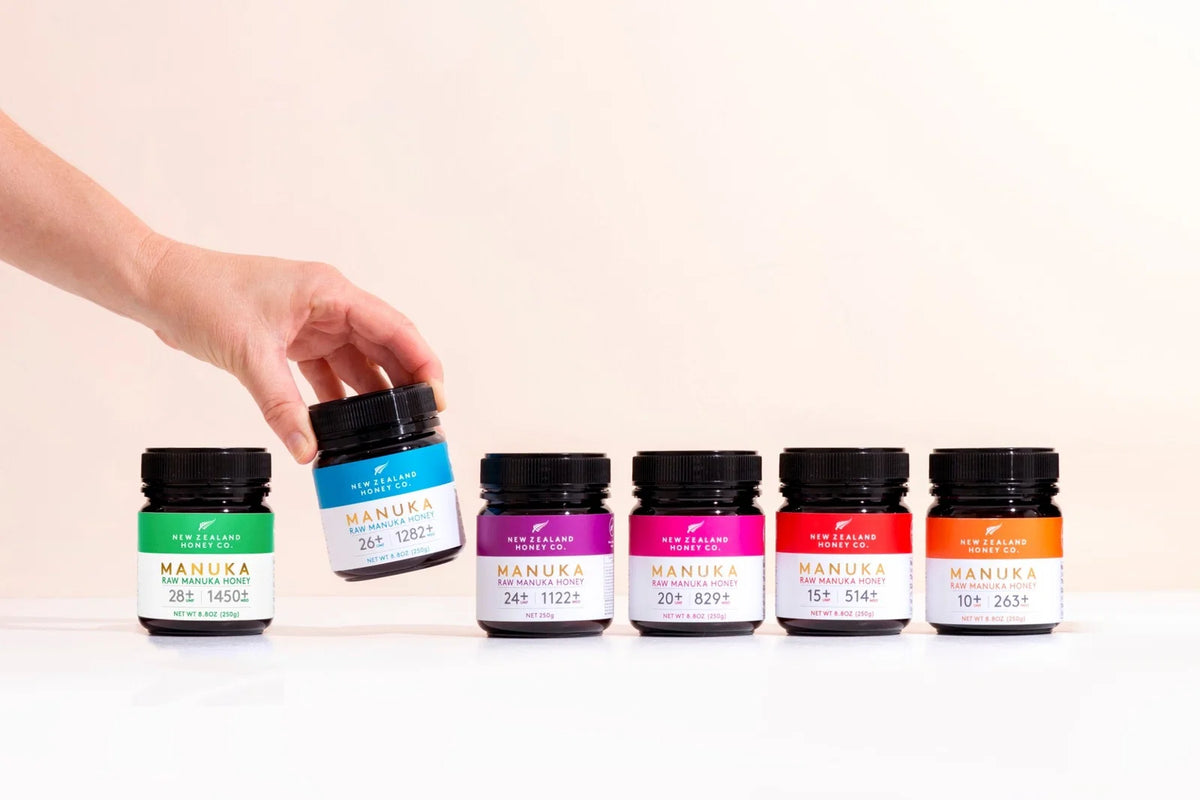
The right grade of manuka honey depends on how you like to enjoy it: UMF™ 10+ or 15+ for an everyday spoonful, UMF™ 20+ or 24+ for a richer daily ritual, and UMF™ 26+ or 28+ if you want our rarest grades.
If you have ever stood in front of a shelf of jars wondering "what UMF™ or MGO grade of manuka honey should I buy?", you are not alone. It is one of the most common questions people ask about manuka honey, and the answer is rarely "the highest number you can afford." Higher grades cost more and taste stronger, and a higher number isn't the right choice for everyone.
This guide explains what UMF™ means, walks through each grade we offer, and explains how people like to enjoy them, so you can buy with confidence.
What does UMF™ mean in manuka honey?
UMF™ stands for Unique Manuka Factor, a grading system run by the UMF™ Honey Association in New Zealand. A UMF™ rating tells you two things: the honey is genuine New Zealand manuka, and its grade. The higher the number, the higher the level of naturally occurring MGO in the honey.
To earn a UMF™ rating, each batch is independently tested for four markers:
- MGO (methylglyoxal): a naturally occurring compound in manuka honey, measured in milligrams per kilogram, which sets the grade.
- Leptosperin: a chemical marker found only in manuka nectar, which proves authenticity.
- DHA (dihydroxyacetone): the precursor that slowly converts into MGO as the honey matures.
- HMF: a freshness marker that shows the honey hasn't been overheated or stored too long.
UMF™ vs MGO: what's the difference?
You will often see MGO numbers on labels instead of UMF™. MGO measures only methylglyoxal, in milligrams per kilogram. UMF™ covers MGO plus authenticity and freshness. The two scales line up closely, so UMF™ 10+ equals roughly MGO 263+, and UMF™ 20+ equals roughly MGO 829+. The table near the end of this guide gives the full MGO to UMF™ conversion chart.
Important: never give honey to babies under 12 months old
- This includes manuka honey of every UMF grade, raw or added to food and drinks.
UMF™ 10+: an everyday honey for the whole family
UMF™ 10+ (MGO 263+) is our everyday manuka and the entry point to the range. It is a natural, everyday addition to a balanced diet, and it fits gluten-free, vegetarian and halal diets.
UMF™ 10+ manuka honey: who is it best for? We recommend UMF™ 10+ for kids (over 12 months), teens, young adults and families with active lifestyles. Most people enjoy:
- 1 teaspoon daily, straight from the spoon or stirred into tea, yogurt, porridge or smoothies
- A spoonful as part of a morning wellness routine
- A little on toast as a tasty, natural swap for regular honey
The taste is smooth and buttery, with soft caramel notes. If you are asking "what UMF™ strength manuka honey should I take daily", UMF™ 10+ is the place to start.
UMF™ 15+: a richer everyday honey
UMF™ 15+ (MGO 514+) is a step up from UMF™ 10+, made for people who live an active lifestyle and care about what goes in (and on) their body. It suits anyone who wants a daily honey with a higher MGO level as part of their everyday wellbeing routine.
The suggested serving is the same as UMF™ 10+: 1 teaspoon daily. The taste is rich and malty with an earthy undertone.
Looking for something comforting? Many people enjoy a spoonful of UMF™ 15+ stirred into warm (not boiling) water with lemon. For on-the-go convenience, we also make Manuka Throat Spray MGO 514+ with Propolis and Manuka Honey Soothing Drops with Lemon MGO 250+.

Manuka Honey UMF™ 15+ | MGO 514+
You’re living an active lifestyle and you care about what goes in (and on) your body. This UMF™ 15+ Manuka Honey is optimised for life, to help you get the most out of your da…
Shop NowUMF™ 20+ and UMF™ 24+: our best sellers
- UMF™ 20+ and UMF™ 24+ are our best-selling grades, chosen by people who want a richer, more concentrated manuka as part of their daily routine.
- UMF™ 20+ (MGO 829+): a high-grade manuka for your daily wellbeing routine, inside and out. Raw and unprocessed to preserve its natural enzymes, it is lovely straight from the jar, added to food and drink, or used as part of a natural skincare routine. Suggested serving: 1 teaspoon daily. It has a bold, herbal flavor.
- UMF™ 24+ (MGO 1122+): a premium grade for people who want an extra lift in their morning routine. Many enjoy it on its own before breakfast. Suggested serving: ½ to 1 teaspoon daily. It has a full, deep toffee flavor with a pleasant bitter edge.
UMF™ 26+ and UMF™ 28+: our rarest grades
What is the highest grade of manuka honey we feature here? UMF™ 28+ (MGO 1450+) is one of the rarest grades of manuka honey, and only the smallest quantity of each harvest reaches it. These grades have higher MGO levels, so our suggested serving is smaller.
- UMF™ 26+ (MGO 1282+): an ultra-rare grade for experienced manuka lovers. Suggested serving: ½ to 1 teaspoon daily.
- UMF™ 28+ (MGO 1450+): ultra-premium, one of the rarest grades we harvest, and a special gift for someone who loves manuka. Suggested serving: ½ teaspoon daily.
The flavor is dense, woody and complex, with a long, lingering finish at UMF™ 28+.
UMF™ vs MGO comparison table: which manuka honey strength should I buy?
Use this MGO to UMF™ conversion chart to compare the grades we offer.
| UMF grade | MGO equivalent (mg/kg) | Daily Serving | Best for | Taste |
|---|---|---|---|---|
| UMF 10+ | 263+ | 1 tsp | Everyday enjoyment for the whole family (over 12 months) | Smooth and buttery, with soft caramel notes |
| UMF 15+ | 514+ | 1 tsp | A richer everyday honey for active lifestyles | Rich and malty, with an earthy undertone |
| UMF20+ | 829+ | 1 tsp | Daily wellbeing routines, inside and out | Bold and herbal, slightly medicinal |
| UMF 24+ | 1122+ | ½–1 tsp | An extra lift in your morning routine | Deep toffee flavor with a pleasant bitter edge |
| UMF 26+ | 1282+ | ½–1 tsp | Experienced manuka lovers | Dense and dark, with burnt-caramel and mineral notes |
| UMF 28+ | 1450+ | ½ tsp | Rare, ultra-premium manuka and gifting | Robust and woody, with a long, lingering finish |

Manuka Honey UMF™ 24+ | MGO 1122+
For those times in life when quality comes first. This pure UMF™ 24+ Manuka Honey is powerfully active, sourced from wild and rugged locations around Aotearoa New Zealand and …
Shop NowHow to buy authentic manuka honey
When buying manuka honey, how important is UMF™ certification? Very. Genuine manuka is in high demand, so check for:
- The UMF™ trademark and licence number on the label, which you can verify with the UMF™ Honey Association.
- Packed in New Zealand. Genuine UMF™ honey is tested and packed there.
- A batch number that links the jar to its lab results.
- Clear grading. Be wary of vague terms like "active" or "bio-active" with no UMF™ or MGO number.
At New Zealand Honey Co, every jar carries a verified UMF™ rating, so you know exactly what strength you are getting. Not sure where to start? Our Manuka Honey UMF™ 10+ MGO 263+ is a great everyday choice, UMF™ 20+ and UMF™ 24+ are our best sellers, or browse the full manuka honey range from UMF™ 10+ upward. You can also use our Which Manuka Honey Is Right for You guide.
What UMF rating is equivalent to MGO 514?
MGO 514 equals UMF 15+.
What MGO level is UMF 20?
UMF 20+ equals MGO 829+.
Is higher UMF always better?
Not necessarily. Higher grades are more potent, but for cooking or a daily teaspoon, UMF 5+ or 10+ gives you great value. Save the high grades for targeted uses.
How much manuka honey should I take a day?
Most people take one to two teaspoons a day. Manuka is still a sugar, so people managing diabetes should check with their doctor first, and honey should never be given to babies under 12 months.
Finding your strength
The best manuka honey is the one that suits how you like to enjoy it. Choose UMF™ 10+ or 15+ for an everyday spoonful, UMF™ 20+ or 24+ for a richer daily ritual, and UMF™ 26+ or 28+ for our rarest grades. Whatever grade you pick, look for genuine UMF™ certification so you know exactly what is in the jar.
Disclaimer
- This article is for general information only. It is not medical advice and does not replace advice from your doctor or another qualified health professional. Manuka honey is a food, not a medicine, and is not intended to diagnose, treat, cure or prevent any disease. Serving suggestions are general guidance for healthy adults and children over 12 months. If you are pregnant or breastfeeding, managing diabetes or another health condition, taking medication, or have a pollen or bee-product allergy, talk to your healthcare professional before adding manuka honey to your routine.

Multifloral vs Monofloral Manuka Honey: What the Difference Means
The short answer Monofloral Manuka honey comes mostly from Manuka flowers. Multifloral Manuka honey comes from Manuka plus other flowers. Both are real Manuka...
Manuka Honey as a Gift: 7 Things to Look For
Gifting Manuka Honey can be a thoughtful way to show you care, but with different grades, labels and strengths to choose from, finding the...

Manuka Honey for a Sore Throat: Best MGO Level to Use
That scratchy, raw feeling at the back of the throat is hard to ignore. Here's why Manuka Honey helps, which MGO level to choose,...
