
EDUCATION
Manuka Honey vs Peptides: Can Nature Deliver What the Lab Promises?
10 minutes
Essential Takeaways
Peptides and Manuka honey represent two different wellness philosophies. Peptides are engineered for targeted, mechanism-driven results, while Manuka honey delivers multi-functional support through a naturally occurring bioactive matrix. If you prefer whole-food, naturally derived approaches to skin, gut, and immune health, high-grade Manuka honey offers a scientifically grounded alternative rooted in biological complexity rather than laboratory precision.
Peptides are one of the most talked-about ingredients in modern wellness.
They appear in anti-ageing serums, gut health supplements, and advanced biohacking protocols and for good reason. The science behind many peptide applications is compelling. But as consumers become more ingredient-aware, a different question is emerging:
Does achieving similar outcomes require laboratory engineering?
This is where Manuka Honey enters the conversation.
Both peptides and Manuka honey are discussed in the context of skin health, gut function, and whole-body wellness. They are not the same thing, their structures, mechanisms, and origins are fundamentally different. But if your goal is to support your skin, digestion, and immune resilience without relying on engineered compounds, understanding how they compare matters.
What Are Peptides, and Why Are They So Popular?
Peptides are short chains of amino acids, the building blocks that form proteins.
Within the body, peptides act as signalling molecules. They communicate with cells, triggering specific biological responses. That precision is exactly what makes them so attractive to researchers and formulators.
In skincare, synthetic peptides are engineered to support collagen signalling, improve skin firmness, and reduce the appearance of fine lines. In supplement form, certain peptides are studied for their potential to support gut lining integrity, muscle repair, and cellular regeneration. In clinical research settings, peptide therapies are being explored across a wide range of applications.
The appeal is clear:
-
Targeted
-
Measurable
-
Mechanism-driven
Peptides are designed to perform a specific function.
However, most therapeutic and cosmetic peptides are synthetically produced or bioidentical compounds, meaning they are engineered in a laboratory to mimic or stimulate natural signalling pathways.
For many people, this is not a concern. For others, particularly those who prioritise whole-food or naturally derived wellness strategies it raises a philosophical question about long-term reliance on engineered inputs.
What Makes Manuka Honey Different?
Manuka honey is produced by bees that forage on the Leptospermum scoparium (Manuka) bush, native to New Zealand.
What distinguishes it from conventional honey is its unique bioactive profile.
The most extensively studied compound in Manuka honey is methylglyoxal (MGO), which contributes to its notable antibacterial activity. Unlike the hydrogen peroxide found in regular honey, MGO remains stable and active under a range of conditions. Medical-grade Manuka honey has been used in clinical wound care settings under professional supervision due to these properties.
Alongside MGO, Manuka honey contains:
-
Dihydroxyacetone (DHA)
-
Leptosperin
-
Naturally occurring antioxidants
-
A complex array of phenolic compounds
Crucially, Manuka honey is not a single-compound product. It is a whole-food system, a naturally occurring bioactive matrix where multiple compounds work together synergistically.
This complexity is not a limitation. For many applications, it is precisely the strength.
Manuka Honey vs Peptides for Skin Health
The comparison between Manuka honey and peptides is most visible in skincare — particularly in the anti-ageing category.
Search interest in terms such as “peptides for skin,” “peptides for collagen,” “Argireline vs Botox,” and “copper peptides for skin repair” has grown significantly in recent years. Consumers are increasingly seeking targeted solutions for firmness, fine lines, and skin regeneration.
Many of the most searched skincare peptides include:
-
Matrixyl® (palmitoyl pentapeptide-4) — commonly formulated to support collagen signalling
-
Argireline® (acetyl hexapeptide-8) — often referred to as a “Botox alternative” for expression lines
-
Copper peptides (GHK-Cu) — studied for their role in skin repair and regeneration
-
Palmitoyl tripeptide-1 and palmitoyl tetrapeptide-7 — frequently used in firming serums
These ingredients are engineered to stimulate highly specific cellular pathways. Most function by signalling fibroblasts — the cells responsible for producing collagen and elastin — encouraging structural proteins associated with firmer-looking skin.
This precision is part of their appeal. Peptides are designed to do one job, and do it well.
Manuka honey, however, approaches skin health from a fundamentally different angle.
Rather than targeting a single signalling pathway, Manuka honey supports the broader skin environment:
-
Its antibacterial activity helps maintain microbial balance on the skin’s surface.
-
Its antioxidant compounds help reduce oxidative stress — a contributor to visible skin ageing.
-
Its natural humectant properties draw moisture into the skin.
-
Its acidity supports the integrity of the skin barrier.
In clinical settings, medical-grade Manuka honey has been used under supervision in wound management and compromised skin care, due to its ability to help create conditions where healing can occur.
The distinction is important:
Peptides such as Matrixyl®, Argireline®, or GHK-Cu are designed to influence defined biological signals linked to collagen and skin structure.
Manuka honey supports hydration, barrier function, antioxidant protection, and microbial balance simultaneously — through a naturally occurring bioactive matrix.
For those searching for a natural alternative to peptide-based skincare, Manuka honey is not a direct replacement for engineered collagen-signalling compounds. Instead, it represents a broader, whole-environment approach to skin health — one rooted in biological complexity rather than molecular precision.
Both strategies have scientific grounding. The choice depends on whether you prioritise targeted laboratory-designed pathways or multi-functional natural systems.
Manuka Honey vs Peptides for Gut Health
Gut health is another area where peptides and Manuka honey are increasingly discussed together.
Certain peptides — including collagen peptides and specific bioactive sequences — are being studied for their potential to support digestive barrier function and immune modulation within the gut. These are targeted, mechanism-specific interventions.
Manuka honey operates through a broader biological profile.
Laboratory studies have demonstrated activity against certain bacteria, including Helicobacter pylori, a microorganism associated with gastric discomfort. At the same time, emerging research suggests Manuka honey may exhibit prebiotic potential — meaning it may help support the growth of beneficial gut bacteria.
The naturally occurring oligosaccharides and polyphenols in Manuka honey provide substrates that beneficial microbes can utilise, contributing to a more balanced microbiome environment.
This distinction matters.
Peptides arrive as isolated signalling molecules.
Manuka honey arrives as a biologically active whole food, delivering multiple interacting compounds that work in parallel.
For individuals seeking digestive support through natural dietary inputs rather than isolated supplementation, that difference is significant.
Synthetic Precision vs Natural Complexity
At its core, the comparison between peptides and Manuka honey is philosophical as much as scientific.
Peptides represent the precision model of modern wellness:
Identify a mechanism. Engineer a molecule. Deliver a targeted outcome.
This approach has driven significant advancements across medicine and cosmetic science.
Manuka honey represents a different model one rooted in biological complexity. Its bioactive compounds evolved together within a living system. Researchers continue to study how these compounds interact, and the full extent of their synergistic behaviour is still being mapped.
This does not make Manuka honey universally superior. It does mean that for those who prefer:
-
Whole-food strategies
-
Multi-functional support
-
Naturally occurring bioactives
-
Long-standing traditional use
High-grade Manuka honey offers a scientifically grounded option that aligns with that philosophy.
It supports skin health, digestive balance, and immune function through a complex network of compounds — without laboratory engineering.
What to Look For in High-Quality Manuka Honey
Not all Manuka honey is equal.
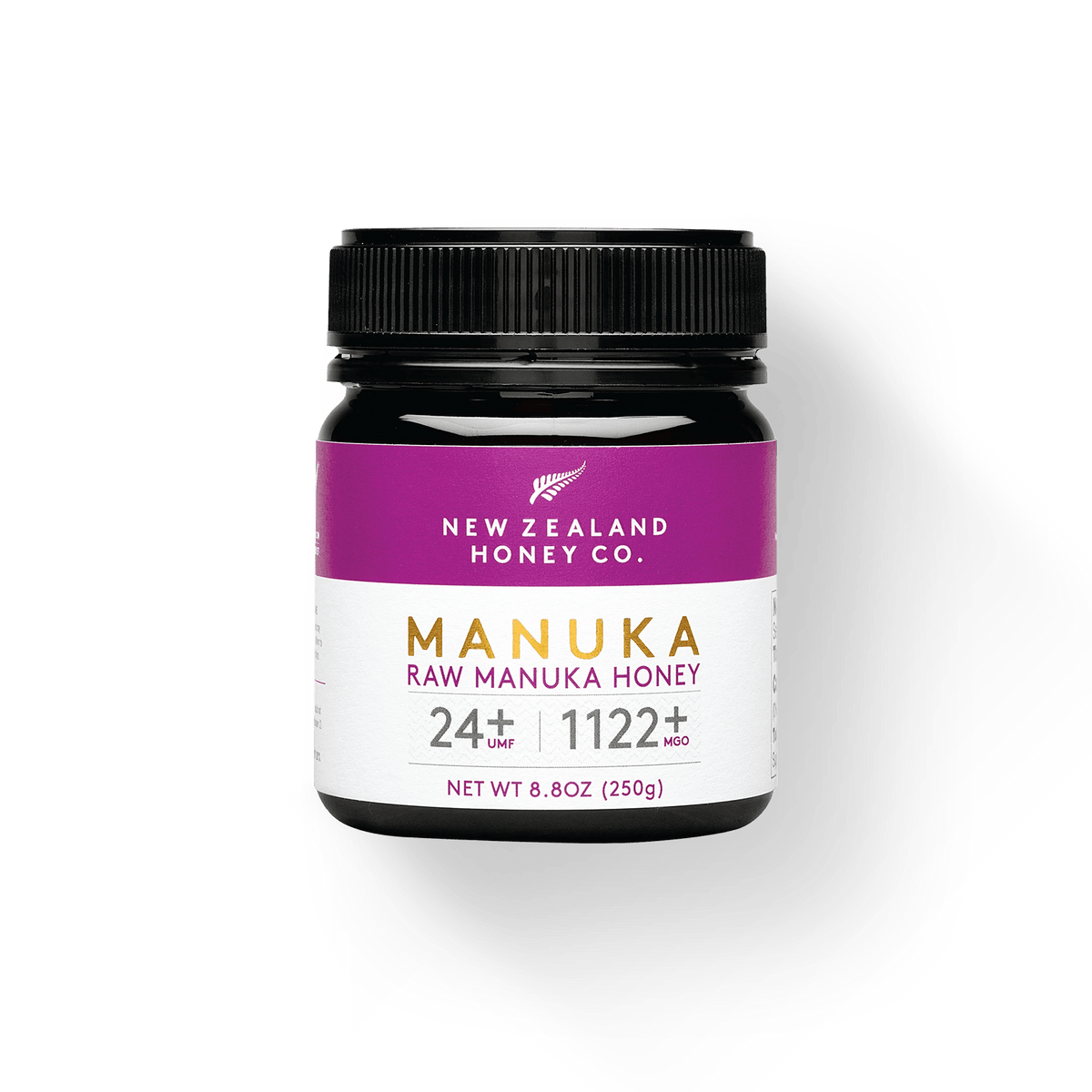
The MGO level, the primary marker associated with antibacterial potency, varies significantly between products.
For general wellness use, many consumers begin with MGO 250+.
Higher grades, such as MGO 400+, are often chosen by those seeking more intensive support.
Look for:
-
Independent laboratory testing
-
Full traceability to New Zealand
-
Recognised grading systems such as UMF™ or verified MGO labelling
Choosing a certified, independently tested product ensures both potency and authenticity
Frequently Asked Questions
Is Manuka honey a peptide?
No. Manuka honey is a natural honey composed primarily of sugars, enzymes, antioxidants, and unique bioactive compounds. It is not a peptide-based product.
Does Manuka honey contain peptides?
Trace peptides may be detected during laboratory analysis and are sometimes used in authentication research. However, peptides are not responsible for the recognised properties of Manuka honey.
Is Manuka honey a natural alternative to peptides?
They function differently. Peptides are engineered signalling molecules designed to target specific biological pathways. Manuka honey is a naturally occurring bioactive food that works through multiple interacting compounds. The right choice depends on your personal wellness philosophy.
The Bottom Line
Peptides and Manuka honey are not direct competitors. They originate differently, function differently, and reflect different approaches to health.
Peptides represent precision engineering.
Manuka honey represents biological complexity.
If you are already curious about peptides, that curiosity is well-founded — the science is real. But before committing to laboratory-engineered compounds, it is worth considering whether a whole-food, bioactive option may align more closely with your long-term approach to wellness.
For those who value natural, multi-functional support across skin, gut, and immune health, high-grade Manuka honey makes a compelling case — not as a replacement for science, but as an expression of it through nature.
Your wellness journey starts with a spoonful a day.
SUBSCRIBE TO OUR NEWSLETTER
Receive our latest releases, offers, guides and more.
