


Manuka Honey Articles · 6 min read
UMF™ vs MGO: How to Compare Ratings and Choose a Manuka Strength
 By Clare
27 Oct 2026

Manuka Honey Articles · 6 min read
UMF™ vs MGO: How to Compare Ratings and Choose a Manuka Strength
By Clare
27 Oct 2026
Manuka Honey Articles · 6 min read
UMF™ vs MGO: How to Compare Ratings and Choose a Manuka Strength
By Clare
27 Oct 2026
Shopping for Manuka honey can feel like reading a code. One jar says UMF™ 20+, another says MGO 829+, and a third shows both. Are they the same thing? Which number matters? And which Manuka honey strength is right for you?
You will learn what UMF™ and MGO mean, how the two ratings compare, and how to convert one to the other. We cover every grade in the New Zealand Honey Co. range, from UMF™ 10+ to UMF™ 28+, so you can pick your jar with confidence.
What is UMF™? The Unique Manuka Factor explained
UMF™ stands for Unique Manuka Factor. It is a trademarked grading system run by the Unique Manuka Factor Honey Association (UMFHA) in New Zealand. Only licensed New Zealand producers can put the UMF™ mark on a jar.
A UMF™ rating is more than a strength score. To earn it, every batch is tested by an independent lab for several natural markers found in genuine Manuka honey:
- MGO (methylglyoxal) – the compound that gives Manuka its signature strength
- Leptosperin – a marker found in the nectar of the Manuka flower, used to confirm the honey is authentic Manuka
- DHA (dihydroxyacetone) – the natural building block of MGO
- HMF – a marker that checks the honey is fresh and has not been overheated
The UMF™ number on the label (10+, 15+, 20+ and so on) reflects the strength. The UMF™ mark itself tells you the honey has also passed the purity and authenticity checks. Think of UMF™ as a full quality certificate, not just one number.
What is MGO? Methylglyoxal in Manuka honey
MGO stands for methylglyoxal, a natural compound that forms in Manuka honey as it matures. It is the main reason Manuka honey is different from everyday table honey.
An MGO rating tells you how much methylglyoxal is in the honey, measured in milligrams per kilogram (mg/kg). So MGO 829+ means the honey contains at least 829 mg of methylglyoxal in every kilogram. The higher the MGO number, the stronger the Manuka honey.
MGO is easy to understand because it is a direct lab measurement. But on its own, an MGO number only tells you about one compound. It does not confirm the honey is genuine monofloral Manuka or that it is fresh.
UMF™ vs MGO: what is the difference?
The simple answer: MGO measures one thing, UMF™ measures several. Both use the same MGO test for strength, so a UMF™ grade and its matching MGO number describe the same potency. The difference is what else is checked.
| UMF™ rating | MGO rating | |
|---|---|---|
| What it measures | MGO, leptosperin, DHA and HMF | Methylglyoxal only |
| Proves authenticity | Yes, leptosperin confirms genuine Manuka | No |
| Checks freshness | Yes, via HMF | No |
| Who controls it | UMFHA, a licensed New Zealand system | Any brand can print it |
| Number style | Small scale (10+, 15+, 20+…) | Large scale in mg/kg (263+, 514+, 829+…) |
| Independent testing | Required for every batch | Depends on the brand |
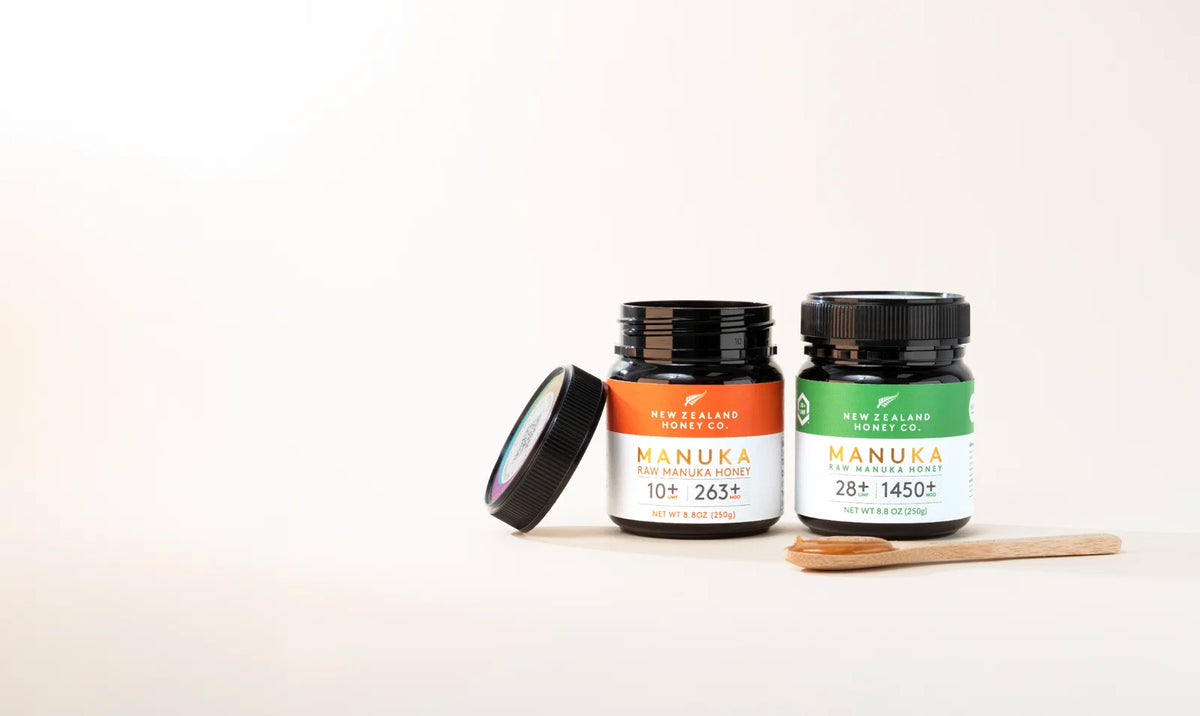
When you compare UMF™ vs MGO, look for a jar that shows both. You get the easy-to-read MGO strength plus the full authenticity checks behind the UMF™ mark. Every New Zealand Honey Co. jar carries both ratings.
UMF™ to MGO conversion chart (UMF™ 10+ to 28+)
Use this UMF™ to MGO conversion chart to compare Manuka honey grades side by side. Each UMF™ grade has a matching minimum MGO level set by the UMFHA.
| UMF™ 10+ | MGO 263+ | Everyday strength |
| UMF™ 15+ | MGO 514+ | Mid strength |
| UMF™ 20+ | MGO 829+ | High strength |
| UMF™ 24+ | MGO 1122+ | Very high strength |
| UMF™ 26+ | MGO 1282+ | Ultra-high strength, rare |
| UMF™ 28+ | MGO 1450+ | Ultra-high strength, very rare |
Quick tip: the MGO number does not rise in a straight line. Going from UMF™ 10+ to UMF™ 20+ more than triples the MGO level, from 263+ to 829+. That is why higher grades are rarer and priced higher.
How to choose a Manuka honey strength
There is no single "best" Manuka honey strength. The right grade depends on how you plan to use it, how often, and your budget. Here is a simple guide to each grade.
UMF™ 10+ | MGO 263+: the everyday Manuka
UMF™ 10+ Manuka honey is the ideal starting point. It has a smooth, rich flavour that works well stirred into tea, spread on toast or added to yoghurt. Choose it if you are new to Manuka honey or want a jar for the whole family to enjoy daily.
UMF™ 15+ | MGO 514+: the all-rounder
UMF™ 15+ nearly doubles the MGO level of 10+. It is a popular middle ground for people who enjoy Manuka every day and want a step up in strength without moving into premium pricing.
UMF™ 20+ | MGO 829+: high-grade Manuka
UMF™ 20+ is where high-strength Manuka honey begins. Many regular Manuka buyers settle here. It has a deeper, more intense taste and is often taken straight off the spoon.
UMF™ 24+ | MGO 1122+: very high strength
UMF™ 24+ Manuka honey is for people who want serious potency. Only a small share of Manuka harvests reach this grade. It is a great choice for a daily spoonful ritual.
UMF™ 26+ | MGO 1282+: rare and ultra-high
UMF™ 26+ is an ultra-high grade that few hives ever produce. Choose it if you want one of the strongest certified Manuka honeys available, or as a premium gift.
UMF™ 28+ | MGO 1450+: the ultra honey
UMF™ 28+ is the strongest grade in this range. It is extremely rare, with the highest MGO level and the most intense flavour. This is the jar for true Manuka enthusiasts.
Not sure where to start? Pick UMF™ 10+ or 15+ for everyday enjoyment. Choose UMF™ 20+ or 24+ if you want high strength for daily use. Go for UMF™ 26+ or 28+ when you want the rarest Manuka honey money can buy.
How to spot genuine Manuka honey: a label checklist
Not every jar labelled "Manuka" is the real thing. Before you buy, check the label for these signs of authentic Manuka honey:
- The UMF™ trademark and a number, such as UMF™ 20+. This shows the honey is licensed and graded by the UMFHA.
- A matching MGO rating, such as MGO 829+, so you can compare strength easily.
- "Produced in New Zealand" and packed in New Zealand. Genuine Manuka honey comes from New Zealand.
- "Monofloral Manuka", meaning the honey comes mainly from the Manuka flower.
- A traceable batch or lot number. On every New Zealand Honey Co. jar, you can scan the QR code to see the official UMF™ certificate, the independent lab results from Hill Laboratories and the region your honey came from.
Extra certifications can help too. Our Manuka honey is also Halal certified by FIANZ, Non-GMO Project Verified and certified free of herbicides.
UMF™ vs MGO: frequently asked questions
Is UMF™ or MGO better? Neither number is "better" for strength, because UMF™ grades are based on MGO levels. UMF™ is the more complete rating because it also confirms authenticity and freshness.
Is UMF™ 10+ the same as MGO 263+? Yes. UMF™ 10+ means the honey has at least 263 mg/kg of methylglyoxal, which is MGO 263+.
What does the "+" mean on Manuka honey? The plus sign means "at least". A UMF™ 24+ jar contains a minimum of MGO 1122+, and the tested batch may be slightly higher.
Why is high-grade Manuka honey more expensive? Higher grades such as UMF™ 26+ and UMF™ 28+ are rare. Only a small share of Manuka honey ever reaches these MGO levels, so supply is limited.
Does Manuka honey strength change over time? MGO is stable once the honey is graded. Store your jar at room temperature, away from direct sunlight, and always use a clean, dry spoon.
Can I use a UMF™ to MGO converter? Yes. Use the conversion chart above, or our online MGO vs UMF™ calculator, to compare any Manuka honey grade.
Choose your Manuka honey strength with confidence
Comparing UMF™ vs MGO is simple once you know the basics. MGO tells you the strength in mg/kg. UMF™ tells you the strength and confirms you are buying genuine, fresh New Zealand Manuka honey. The best choice is a jar that shows both.
To recap: choose UMF™ 10+ or 15+ for everyday enjoyment, UMF™ 20+ or 24+ for high strength, and UMF™ 26+ or 28+ for the rarest grades.
Ready to find your jar? Explore the full New Zealand Honey Co. range of UMF™ certified Manuka honey, from UMF™ 10+ | MGO 263+ to UMF™ 28+ | MGO 1450+. Every jar is independently tested in New Zealand and fully traceable from hive to home.
Source for grade equivalents and certification details: New Zealand Honey Co. and an example UMF™ 28+ batch certificate.
Which Manuka Honey Strength Is Right for You? A Guide by Need
Essential takeaways The right manuka honey strength depends on what you want it to do. Higher UMF™ means more MGO, the natural compound behind...

Multifloral vs Monofloral Manuka Honey: What the Difference Means
The short answer Monofloral Manuka honey comes mostly from Manuka flowers. Multifloral Manuka honey comes from Manuka plus other flowers. Both are real Manuka...

What Strength of Manuka Honey Should I Have? A Guide to UMF™ Ratings
The right grade of manuka honey depends on how you like to enjoy it: UMF™ 10+ or 15+ for an everyday spoonful, UMF™ 20+...
