


Manuka Honey Articles · 8 min read
Is Manuka Honey Worth the Price? What You're Actually Paying For
Manuka Honey costs more than regular honey for six very specific, very verifiable reasons. From a flowering window as short as two weeks to rigorous UMF™ grading standards, the price tag tells a story of scarcity, science, and genuine quality.
 By Clare
Updated 25 Sep 2026
By Clare
Updated 25 Sep 2026

Manuka Honey Articles · 8 min read
Is Manuka Honey Worth the Price? What You're Actually Paying For
Manuka Honey costs more than regular honey for six very specific, very verifiable reasons. From a flowering window as short as two weeks to rigorous UMF™ grading standards, the price tag tells a story of scarcity, science, and genuine quality.
By Clare
Updated 25 Sep 2026
Manuka Honey Articles · 8 min read
Is Manuka Honey Worth the Price? What You're Actually Paying For
Manuka Honey costs more than regular honey for six very specific, very verifiable reasons. From a flowering window as short as two weeks to rigorous UMF™ grading standards, the price tag tells a story of scarcity, science, and genuine quality.
By Clare
Updated 25 Sep 2026
The short answer: Manuka Honey costs more than regular honey because it comes from a flower that blooms for only a few weeks a year in remote New Zealand terrain, contains a stable active compound (MGO) that regular honey doesn't, and is independently lab-tested before it reaches the label. At one teaspoon a day, a jar of UMF™ 15+ works out to roughly $1.11 per serving, less than most daily coffees.
If you've ever stood in front of a jar of Manuka Honey and wondered whether the price is justified, you're asking the right question. Wellness products have earned a fair amount of scepticism, and plenty of shoppers have paid a premium for something that didn't deliver. So rather than ask you to take our word for it, this guide breaks down exactly where the price comes from, what it works out to per day, how to compare brands fairly, and how to pay less for the grade you actually need.
Why Does Manuka Honey Cost More Than Regular Honey?
1. The flowering season lasts just 2 to 8 weeks
Most honey can be collected whenever flowers are in bloom. Manuka is different. The Manuka tree flowers for only two to eight weeks each year, depending on weather, altitude, and location. A wet spring or an early frost can shorten that window further, and there's no second chance until the following year. Supply is seasonal and limited, while demand stays constant.

2. It's harvested from remote, rugged terrain
The most potent Manuka Honey comes from wild Manuka growing in hard-to-reach parts of New Zealand, not flat, accessible farmland. Beekeepers place hives in these locations ahead of the bloom, maintain them through the season, and transport the honey back out. It's skilled, manual work with far fewer hives per operation than conventional honey production.
3. It contains MGO, a compound regular honey doesn't have in meaningful amounts
Regular honey's antibacterial activity relies mainly on hydrogen peroxide, which breaks down easily with heat and light. Manuka Honey contains methylglyoxal (MGO), a far more stable compound. MGO levels vary naturally from batch to batch, and higher concentrations are rarer, which is why higher grades cost more.
MGO vs Hydrogen Peroxide: A Key Difference
- Regular honey's antibacterial activity relies on hydrogen peroxide, which is unstable and breaks down easily
- Manuka Honey's key compound, MGO, is far more stable
- MGO levels vary naturally and are measured in every certified batch
- The grade on the label tells you exactly how much MGO you're getting
4. Every batch is independently lab-tested
The UMF™ (Unique Manuka Factor) grade is not a marketing badge. It's an independent quality standard that tests four markers in every batch: MGO, Leptosperin, DHA and HMF. Together they confirm authenticity, potency and freshness. Testing is carried out by accredited third-party laboratories, not the producer, so the numbers on the label are verified results, not estimates.
What UMF™ Testing Actually Involves
- Four compounds tested per batch: MGO, Leptosperin, DHA, and HMF
- Testing is done by accredited, independent laboratories, not the producer
- The results set the UMF™ grade printed on the label
- Every jar has a QR code that traces the batch back to its source
- So you know exactly what you're paying for before you buy
What Does Manuka Honey Actually Cost Per Day?
The sticker price of a jar tells you very little on its own. What matters is how long it lasts. A standard [250g / 8.8oz] jar holds about 35 teaspoons, so at one teaspoon a day, one jar lasts around five weeks.
What Manuka Honey costs per day, by grade
- UMF™ 10+ / MGO 263+: Best for everyday use, cooking and tea. $18.88 for 250g, about $0.54 per teaspoon ($0.41 in the 500g jar).
- UMF™ 15+ / MGO 514+: Best for a daily wellness routine. $38.88 for 250g, about $1.11 per teaspoon ($0.96 in the 500g jar).
- UMF™ 20+ / MGO 829+: Best for daily wellness with higher potency. $63.88 for 250g, about $1.83 per teaspoon ($1.56 in the 500g jar
- UMF™ 24+ / MGO 1122+: A higher-potency option. $108.88 for 250g, about $3.11 per teaspoon ($2.66 in the 500g jar).
- UMF™ 26+ / MGO 1282+: For those seeking very high potency. $175.88 for 250g, about $5.03 per teaspoon ($4.27 in the 500g jar).
- UMF™ 28+ / MGO 1450+ and UMF™ 30+ / MGO 1620+: Our rarest grades, from $298.88 for 250g, about $8.54 per teaspoon.
Put that next to a daily coffee, a smoothie or a supplement, and the numbers look very different from the price tag on the jar.
What Our Customers Say
I ordered this honey the very first time and the quality is so good that I will definitely order it again. I know the price is on the high side but it’s worth every penny. Thank you honey
— Verified Customer, USA, UMF™ 26+ | MGO 1282+
Taste is really good and it’s caramel in color. I had low energy issues and after taking it my concentration and energy levels came back and I feel active the whole day. Plus the antibacterial effect is a plus point for taking Manuka Honey. it's expensive but worth it.
— Haider N., UMF™ 15+ | MGO 514+
How to Compare Manuka Honey Brands Fairly
Comparing Manuka Honey to supermarket honey only tells half the story. If you're weighing up different Manuka brands, these are the numbers that matter:
Price per MGO. Two jars at the same price are not equal if one is MGO 263+ and the other is MGO 514+. Divide the price by the MGO number to see which gives you more active compound for your money.
Price per gram. Jar sizes vary between brands. A cheaper jar that holds less honey can end up costing more per serving.
UMF™ certification vs MGO-only labels. MGO-only labels measure one compound. UMF™ certification tests four, including Leptosperin, which confirms the honey is genuine Manuka. If a jar doesn't show a guaranteed UMF™ or MGO number at all, treat that as a red flag.
Traceability. Every New Zealand Honey Co. jar has a QR code that traces the batch back to its source, so you can check exactly what you're buying.
What Actually Matters When Choosing Manuka Honey
Key Points to Remember
- At one teaspoon a day, Manuka Honey starts from 54¢ per serving.
- Compare brands on price per MGO and price per gram, not jar price
- UMF™ 10+ to 15+ is plenty for everyday use; you don't need the highest grade
- UMF™ grades are independently tested and guaranteed, not estimated
- Every New Zealand Honey Co. jar is traceable to its source via QR code
- Subscribing saves up to [25%], and bundles lower the cost per serving
How to Get the Best Value on Manuka Honey
Practical Ways to Pay Less Without Compromising on Quality
-
Choose the grade that matches your goal
UMF™ 10+ to 15+ suits everyday use, like a morning spoonful or tea. UMF™ 20+ and above is typically chosen by those looking for higher potency. Buying the right grade, rather than the most expensive one, is the easiest way to save.
-
Compare on MGO, not jar price
Divide the price by the MGO number, and check the jar size. A cheaper jar with lower MGO or less honey can cost more per serving. If a label doesn't show a guaranteed UMF™ or MGO figure, look elsewhere.
-
Subscribe and save
Our subscription discount grows the longer you stay, from [20%] to [23%] to [25%] off. For a daily habit, the savings add up quickly.
-
Build a consistent daily habit
A single spoonful each morning is a common approach. Consistency matters more than quantity. Taking Manuka Honey regularly as part of a broader wellness routine is how most people find it supports their health goals over time.
What the Research Says
Manuka Honey is one of the most studied honeys in the world, and much of that research focuses on its use on the skin. A randomised controlled trial in critically ill children found that wounds dressed with Manuka and active Leptospermum honey healed in a median of 7 days, compared with 9 days under standard care, with no allergic reactions or secondary infections reported [1]. A separate study found that Manuka Honey applied to atopic dermatitis lesions led to clinical improvement and reduced inflammatory markers in skin cells [2].
These studies looked at topical, medical-grade use, not a daily spoonful, and Manuka Honey isn't a substitute for medical care. What they do show is that its active compounds are real, measurable and worth studying, which is exactly what independent UMF™ testing verifies on every jar.
Frequently Asked Questions
Why is Manuka Honey so expensive?
It comes from a flower that blooms for only 2 to 8 weeks a year, is harvested from remote New Zealand terrain, contains the stable compound MGO, and is independently lab-tested for authenticity and potency. At one teaspoon a day, it works out to around [$X.XX] per serving.
Is cheap Manuka Honey fake?
Not necessarily. Lower grades like UMF™ 10+ are genuinely less expensive because they contain less MGO. The warning signs are a missing UMF™ or MGO number, vague terms like "active" or "bio-active" without a figure, or no way to trace the batch.
What UMF™ grade do I need?
For everyday use, UMF™ 10+ to 15+ is plenty. UMF™ 20+ and above is for those who want higher potency. Match the grade to how you plan to use it.
What's the cheapest way to buy Manuka Honey?
Choose the grade that fits your needs, buy larger jars or bundles, and subscribe for up to [25%] off
How long does a jar last?
A [250g / 8.8oz] jar holds about 35 teaspoons, or roughly five weeks at one teaspoon a day.
The Bottom Line
Manuka Honey's price traces back to real, verifiable factors: a short and unpredictable season, remote harvesting, a rare active compound, and independent testing on every batch. Broken down per serving, compared on MGO rather than jar price, and bought at the right grade, it's far more accessible than the sticker suggests.
Find the right grade for you. Explore our independently tested range, with guaranteed MGO levels and full traceability on every jar.
Ready to find the right Manuka Honey for you?
Explore our independently tested and certified range, with guaranteed MGO levels and full traceability on every jar. Give it a go and notice the difference for yourself.
Shop Manuka Honey1. Use of Honey Versus Standard Care for Hospital-Acquired Pressure Injury in Critically Ill Children: A Multicenter Randomized Controlled Trial, June 2021, National Library of Medicine.
2. Honey is potentially effective in the treatment of atopic dermatitis: Clinical and mechanistic studies, June 2017, National Library of Medicine.
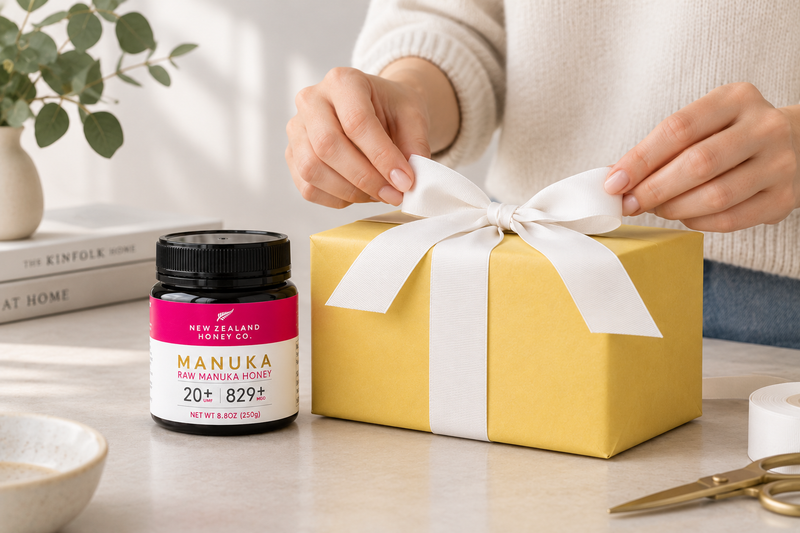
Manuka Honey as a Gift: 7 Things to Look For
Gifting Manuka Honey can be a thoughtful way to show you care, but with different grades, labels and strengths to choose from, finding the...

Manuka Honey for a Sore Throat: Best MGO Level to Use
That scratchy, raw feeling at the back of the throat is hard to ignore. Here's why Manuka Honey helps, which MGO level to choose,...
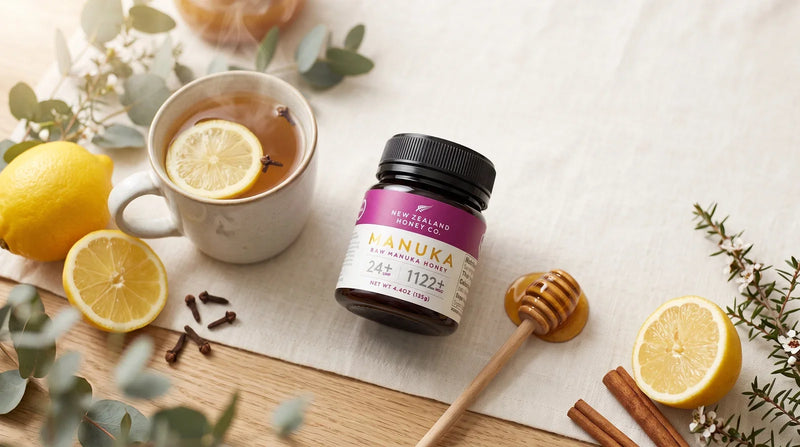
Manuka Honey for Cold & Flu Season 2026/27: Guide
As the 2026/27 cold and flu season approaches, learn how UMF™ Manuka honey can support daily wellness, ease symptoms, and fit alongside medical care...
