
EDUCATION
Manuka Honey for Dogs: Everything You Need To Know
13 minute read
Essential Takeaways
Manuka honey can be a great natural treat for dogs!
Honey is deemed acceptable to give to most dogs in small quantities, as part of a balanced diet and their general wellness routine.
Dogs that are diabetic, obese, immuno-compromised, or still puppies shouldn’t be given any type of honey.
The quantity of Manuka honey that you should give your dog depends on the size of the animal.
When introducing Manuka honey into your dog’s diet, you might start with a mid-range UMF™ grading such as UMF™ 15+ or our Pet Manuka Honey, which contains the equivalent amount of the key active compound, methylglyoxal. Make sure you buy Manuka honey from a trustworthy supplier to ensure authenticity.
Disclaimer: We strongly encourage you to go to the vet whenever your dog is unwell or injured.
Manuka honey can be a great treat for dogs! We've compiled the ultimate guide for you.
We’ll take you on a journey to discover how and why you might want to (safely!) give your dog Manuka honey as part of their everyday wellness routine.
Seeing as vet bills can be extraordinarily high, it’s worth knowing how a quality food like Manuka honey can fit into your dog’s daily diet — while always leaving medical care to your vet.
In this guide on Manuka honey for dogs:
- Is honey good for dogs?
- Which dogs shouldn’t have honey?
- What’s the best honey for dogs?
- Benefits of raw Manuka honey for dogs
- What are researchers studying?
- Can Manuka honey help dog allergies?
- How much Manuka honey can I give my dog?
- How should I give it to my dog?
- Where can I buy it and which strength should I buy?
- FAQs
Let’s get stuck in!
Is Honey Good For Dogs?
“Yes, honey is good for dogs. It’s flavonoid-rich and contains minerals like calcium, magnesium, potassium, and manganese. Feeding honey to your dog is safe for as long as it’s given in small quantities and under the guidance of a veterinarian.” - Outward Hound
Kristin Wuellner, DVM, from Hills Pet Nutrition agrees, saying it’s safe for dogs to have a small amount of honey each day.
Of course, there are exceptions to this, which we’ll dive into straight away so you can understand what you should be keeping in mind when feeding honey to your dog.
Which dogs shouldn’t have honey?
It’s recommended that the following groups of dogs are not given any type of honey:
- Diabetic dogs, because of the high sugar content.
- Young puppies under 12 months old, because their immune systems are still developing.
- Dogs that are allergic to bees and bee stings, because honey might irritate them.
- Dogs with compromised immune systems, as there's a small chance that raw food products like honey can contain botulism spores.
If your dog is adult, healthy, not allergic, and not fussy, then they are in the clear to enjoy a little honey as part of their diet.
What’s The Best Honey For Dogs?
Seeing as your dog can’t tell us which one he or she finds the most tasty, we’re going to look at this from a purely compositional perspective.
Out of all the honeys available, Manuka honey is prized largely for its well-characterised antibacterial and antimicrobial properties.
What makes Manuka honey distinctive?
“[Manuka Honey] has been identified for its increased antimicrobial activity against a range of microorganisms. The increased activity is attributed to the presence of methylglyoxal, not present in other honeys…
Manuka honey still contains the other main components that give rise to honey’s antimicrobial activity; however, the presence of methylglyoxal results in increased activity.”
- US National Library of Medicine
So it’s the antimicrobial activity associated with methylglyoxal (more commonly known as MGO) that sets it apart from other honey.
The bottom line is that:
- MGO is not found in large quantities in other honey.
- MGO is present in high concentrations in Manuka honey.
- Manuka honey is a high-quality, characterful honey for dogs!
Read more: What Does MGO Mean on Manuka Honey?
But can you buy any type of Manuka honey? Or is there a specific type that's better than others?
Unfortunately, there is much more demand for Manuka honey than supply, so it's quite common for fake, diluted and low-grade Manuka products to reach the market.
To ensure that your dog is getting the real deal, look for Manuka honey that is:
- Monofloral: this means it comes from a single nectar source rather than all different types of plants.
- Produced in New Zealand: the NZ government sets very strict standards for Manuka honey exporters, providing quality assurances for buyers.
- From a reputable brand: by selecting a trustworthy brand, you can be more confident that you're getting pure, potent Manuka honey that hasn't been adulterated.
Sounds like a lot of things to look out for, right?
Luckily, there's an easy way to find trustworthy Manuka honey... look for the UMF™ certification. The UMF™ grading system holds Manuka honey producers to the strictest standards in the world, including independent testing and guarantees around potency.
By purchasing UMF™ certified Manuka honey, you can be confident that your dog is getting nothing less than the best.
Bonus tip: opt for a UMF™ 15+ grade or higher. Higher grading numbers mean that there's a stronger concentration of MGO.
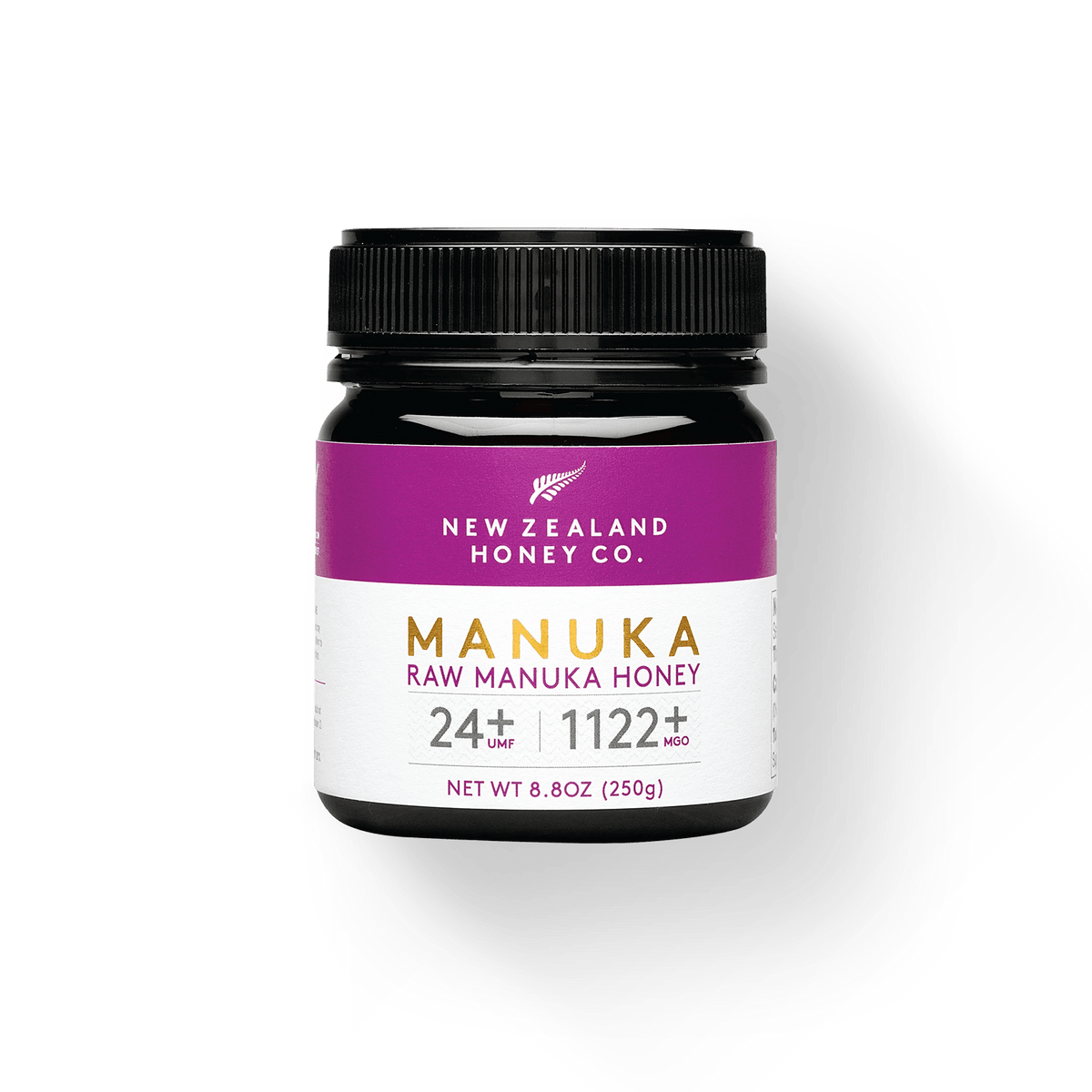
Bonus tip #2: consider getting a dedicated bottle of Manuka honey for your dog that's separate from what you use in human food. We supply a dedicated Pet Manuka Honey product, which contains 550mg/kg of MGO (roughly equivalent to UMF™ 15+) in a convenient squeezy bottle to avoid mess. Get your Pet Manuka Honey here.
Raw Manuka Honey For Dogs
As a naturally sweet, wholefood treat, Manuka honey can be a lovely addition to a healthy dog’s balanced diet.
Here are a few gentle, everyday reasons owners enjoy sharing it with their dogs:
A treat that supports general wellbeing
Offered in small amounts, Manuka honey can be part of your dog’s daily wellness routine.
A tasty topper
Its rich flavour and smooth texture make it an appealing occasional treat, whether given straight or mixed through food.
Part of an oral-care routine
Alongside a regular tooth-brushing routine, a small amount can be a pleasant part of your dog’s day.
These are good reasons to add a little Manuka honey into your dog’s diet as an everyday treat. For anything to do with your dog’s health, injuries or illness, always see your vet first.
What Are Researchers Studying?
Because honey has long been used in veterinary settings, scientists have taken an interest in studying it in the laboratory and in animal studies. Reported at the level these studies reached — and never as a promise about your own dog — here’s a snapshot of that research:
- In laboratory work, researchers found that medical-grade Manuka honey inhibited genetically diverse strains of Staphylococcus pseudintermedius, a bacterium associated with opportunistic infections in dogs, and could reduce some virulence factors in the dish (Brown et al., 2020) [2].
- In an in-vitro comparison, veterinary researchers reported that medical-grade honey showed stronger antibacterial activity than non-medical-grade honeys against common bacterial isolates cultured from dog and cat wounds [6].
- In another laboratory study, researchers observed an additive effect when Manuka honey was combined with conventional antifungals against yeast isolates from dogs and cats [3].
- In a controlled experimental study in dogs, researchers evaluating a proprietary Manuka honey hydrogel measured somewhat higher epithelialisation of surgical wounds at some time points, while contraction and histological scores did not differ between groups [1]. Veterinary reviewers looking at the wider evidence have noted it remains limited [4].
This is early, mostly laboratory-level research into honey in general — not evidence that any honey treats, cures or prevents disease in your dog. For anything involving your dog’s health, please see your vet.
Can Manuka Honey Help Dog Allergies?
The jury is still out on whether or not honey is helpful for allergies. Some believe that consuming small amounts of local honey might be helpful, with the logic being that the body can get used to products from those specific plants.
The general consensus is that it’s not guaranteed to help, but it’s unlikely to cause harm. If Manuka honey isn’t considered your local honey, it might not have that effect anyway.
“Regardless of the lack of conclusive research, feeding your dog a small amount of honey to help with allergens won’t harm him, even if it is not guaranteed or even likely to help.”
So, we’ve looked at how Manuka honey can fit into your dog’s diet as a treat. Now, it’s time to make sure you’re offering it safely.
How Much Manuka Honey Can I Give My Dog?
If you’re about to run to the pantry, stick a spoon into a jar of Manuka honey and call your dog in from the garden, pump the brakes a little.
Let’s talk about how much is a recommended and safe amount to give as a treat.
The amount for your dog depends on the size and weight of the animal.
- Small dogs (under 10 lbs / 4.5 kgs) = ¼ teaspoon a day
- Medium dogs (10-20 lbs / 4.5-9 kgs) = ½ teaspoon a day
- Larger dogs (20-50 lbs / 9-22 kgs) = 1 teaspoon a day
- Large-breed dogs (over 50 lbs / 22 kgs) = 2 teaspoons a day
It’s good to follow these guidelines, as excess consumption could result in hyperactivity because of the high sugar content, and also start to have negative effects on their teeth.
How Should I Give My Dog Manuka Honey?
There are a few different ways - of course you can get creative!
- On a teaspoon. Give it to them straight and enjoy their initial reaction.
- Diluted with water. This turns their treat into a drink.
- Mixed in with dog treats. If you make your own food or treats, simply add Manuka honey to your ingredients list.
Now that you know the how, why, and when, let’s take a look at the where and what.
Tip: get a separate container of Manuka honey for your dog to avoid mixing it with what you eat. Our Pet Manuka Honey is a great option for this purpose.
Where can I buy it and which strength should I buy?
You can use the same Manuka honey on your dog that you'd use for human purposes. If you prefer to have only one container in the cupboard, that's perfectly fine. However, if you prefer to keep your dog's food separate from what you put into your family's body, you may want to get a separate jar - especially if it's for ongoing use.
We offer a dedicated Pet Manuka Honey product, which comes in a convenient squeezy bottle to avoid mess, and comes with a dedicated dosing spoon to help with measuring a consistent amount of honey every time.
This Pet Manuka Honey contains at least 550mg/kg of MGO (the key active ingredient), which is roughly equivalent to UMF™ 15+.
If you'd prefer to get UMF™ certified Manuka honey for your dog, we also supply a wide range from UMF™ 10+ all the way up to UMF™ 30+. You can shop our range here.
Look out for the same markers of quality from your Manuka honey whether it’s for you or your dog!
And avoid supermarket-grade Manuka honey, as it's often diluted or blended with other types of honey to make it go further.
(To learn more about this issue, check out our blog on fake Manuka honey).
What’s the bottom line?
To make sure you get the real deal, only buy authentic products from trustworthy brands, such as our Pet Manuka Honey or UMF™ graded Manuka honey range (UMF™ 15+ or higher is best).
UMF™ stands for Unique Manuka Factor. It is the standardised grading measurement of the Unique Manuka Factor Honey Association (UMFHA). It measures chemical markers of Manuka honey, including MGO, which was the one we discussed in detail above. More info here.
FAQs
Can I give Manuka honey to my diabetic dog?
No. It’s not advised to give any type of honey to a diabetic dog. Always check with your dog’s vet first.
Can puppies have honey?
No. It’s recommended that dogs under 1 year of age shouldn’t be given any type of honey, as their immune systems are still developing and they might not be able to digest it very well.
Which dogs shouldn’t have honey?
Dogs that are allergic to bee stings, diabetic dogs, puppies younger than 1 year, overweight or obese dogs, and immuno-compromised dogs.
Is honey bad for dogs?
No. Honey is considered safe for most dogs, in small quantities. Manuka honey can be a naturally sweet, wholefood treat that fits into your dog’s everyday diet and general wellness routine.
Is Manuka honey helpful for other pets too?
Yes! Manuka honey is enjoyed by horses and cats, too. For more information, take a look at our blogs on using Manuka honey with these animals:
For the use of Manuka honey with your cat or any other pet, we recommend speaking with your veterinarian for advice tailored to your situation.
Your wellness journey starts with a spoonful a day.
SUBSCRIBE TO OUR NEWSLETTER
Receive our latest releases, offers, guides and more.
References
[1] Repellin R, Pitt K, et al. "The effects of a proprietary Manuka honey and essential oil hydrogel on the healing of acute full-thickness wounds in dogs." Veterinary Surgery: VS. 2021. DOI: 10.1111/vsu.13711
[2] Brown H, Metters G, et al. "Antibacterial and Antivirulence Activity of Manuka Honey against Genetically Diverse Staphylococcus pseudintermedius Strains." Applied and Environmental Microbiology. 2020. DOI: 10.1128/aem.01768-20
[3] Váczi P, Čonková E, et al. "Efficacy of manuka honey with conventional antifungals." Polish Journal of Veterinary Sciences. 2023. DOI: 10.24425/pjvs.2023.145037
[4] Brennan M, Belshaw Z. "Does manuka honey improve the speed of wound healing in dogs?" The Veterinary Record. 2020. DOI: 10.1136/vr.m2538
[6] Neo R, Gaonkar P, et al. "Medical-grade honey has superior antibacterial properties against common bacterial isolates in wound cultures of dogs and cats in comparison to non-medical-grade honey types." American Journal of Veterinary Research. 2024. DOI: 10.2460/ajvr.24.07.0188
