
EDUCATION
Manuka Honey for Teeth and Oral Health: Friend or Foe?
13 minutes
Essential Takeaways
It might seem counterintuitive to use honey for teeth and oral care, but there's more to the story. Manuka honey is prized for its natural antibacterial and antioxidant properties, and it can be a considered part of your everyday oral-care and wellness routine.
Researchers have taken a growing interest in manuka honey and oral health, studying how it behaves against oral bacteria and plaque in laboratory and pilot studies. Interestingly, research also suggests that despite its sugar content, honey does not appear to be as harmful to teeth as many other sugary foods — though, as with all sugar, moderation matters.
It is, however, still vital to enjoy Manuka honey as part of a healthy and balanced diet, and not to rely on honey alone to look after your mouth. And always speak with your dentist about your oral-care needs.
Disclaimer: We do not recommend the use of Manuka honey as a replacement for seeking professional medical help. Always consult medical professionals in an emergency. It’s always best to get tailored advice from your dentist about your teeth and oral care.
Manuka honey for teeth?
It might sound like a terrible idea. Honey is pure sugar, right?
Whilst honey does contain sugar, and all sugary foods should be eaten in moderation, there’s so much more to raw Manuka honey when it comes to holistic oral care.
And there’s a growing body of research to explore. In laboratory studies, researchers have reported that manuka honey can inhibit the growth of certain oral bacteria, and in small pilot studies researchers have measured its effect on dental plaque.
So how does Manuka honey fit into your existing oral-care routine? That’s what this guide is all about.
In this guide to Manuka honey for teeth and oral wellness:
Key Research Takeaways
Here’s a quick summary of the research discussed in this article, reported at the level each study reached.
2010: A pilot study of manuka honey and plaque
In a small human pilot study, researchers measured manuka honey's effect on dental plaque alongside chlorhexidine and xylitol chewing gum.
2014: Laboratory research on root canal use
In laboratory studies, researchers investigated manuka honey as a potential root canal disinfectant against gram-positive and gram-negative bacteria.
2017: Laboratory activity against oral bacteria
A 2017 laboratory study reported that manuka honey was active against certain oral bacteria.
2021: Research into honey and oral bacteria
Researchers have studied honey's high osmotic properties and its effect on oral bacteria.
2023: A clinical trial as a periodontal-therapy adjunct
In a 2023 clinical trial, researchers examined manuka honey as an adjunct within periodontal research.
The Surprising Truth About Using Honey for Teeth
We need to look after our mouths - they work hard.
From keeping us nourished to making a good first impression, our oral care can affect many aspects of our overall wellbeing. The World Health Organisation estimates that oral health concerns affect billions of people worldwide, with early attention making a real difference.
There are many different influences on oral health, and sugar consumption is a big one. Sugar can create an environment that feeds bad bacteria in our mouths, eroding the protective enamel from the surface of teeth over time.
Dentists refer to this as “the constant battle”, as bacteria in the mouth shift back and forth throughout the day. Each time you eat or brush your teeth, you swing the odds one way or the other.
So adding honey to your oral-care routine must be a terrible idea, right?
Not necessarily — with an important caveat.
Honey does contain sugar, and sugar should always be eaten in moderation. Our bodies and our teeth are designed to process moderate quantities of sugar, so within a clean and natural diet, Manuka honey can be an enjoyable part of your daily wellness routine.
Before we look more closely at the research into Manuka honey and oral health, let’s cover some of the most frequently asked questions about honey and teeth.
Does honey cause cavities?
Research suggests that honey behaves differently to many other sugars when it comes to teeth, and studies have looked at its impact on dental erosion and early bacterial colonisers. Honey also contains natural antibacterial and antioxidant compounds, along with vitamins, minerals and enzymes.
It is important to remember, however, that honey does contain sugar, and the overconsumption of sugar isn't good for teeth. So enjoy your honey in moderation as part of a balanced diet.
Does honey stain teeth?
According to teeth-whitening experts, honey doesn't stain teeth. The foods most likely to stain teeth are dark in colour, like coffee, red wine, soy sauce, berries and beetroot.
You can help keep your teeth bright by brushing regularly, flossing and using a mouthwash.
Can honey remineralise teeth?
It's possible that honey may play a role in supporting the minerals around our teeth. This is believed to be thanks to its trace amounts of calcium, phosphorus and magnesium, the minerals that form the protective enamel.
That said, there is no specific research confirming this yet, and evidence to date has been mostly anecdotal.
Why do people put honey on their gums?
Manuka honey is well known for its natural antibacterial properties, and many people enjoy it as part of caring for a healthy mouth. Its unique combination of natural compounds includes methylglyoxal (MGO), the antibacterial marker associated with Manuka honey.
Manuka honey is also used in other settings — read more about Manuka honey for wound care.
Should you brush your teeth with honey?
No — using Manuka honey as a toothpaste won't get you the best results. Brushing your teeth is important for removing food and debris and keeping them clean. Manuka honey is better enjoyed as a complement to your usual oral-care routine, not a replacement for brushing.
What the Research Says About Manuka Honey and Oral Health
Researchers have explored manuka honey and oral health from a number of angles. Here’s what some of that research has looked at, reported at the level each study reached. None of this is a substitute for professional dental care — always check with your dentist about your own oral health.
Manuka honey and your gums
Gum health is an area of active research. With growing concern about antibiotic resistance, researchers have been exploring a range of natural materials. In a 2023 clinical trial, researchers examined manuka honey as an adjunct within periodontal therapy research, measuring plaque and bleeding as study outcomes.
As an everyday option, many people simply enjoy a spoonful of Manuka honey, or massage a little into their gums, as part of their oral-care routine.
Manuka honey and oral bacteria
Much of the research into manuka honey and teeth has focused on how it behaves against oral bacteria in the laboratory. A 2017 laboratory study reported that manuka honey was active against certain oral bacteria, and in earlier laboratory studies researchers investigated it as a potential root canal disinfectant. Researchers have also studied manuka honey combined with zinc oxide eugenol as a root-filling material in an in-vitro study of extracted teeth [3].
Manuka honey and mouth ulcers
Mouth ulcers are common and usually heal on their own. Researchers have studied honey in this area — for example, comparing honey with a topical corticosteroid in a study of recurrent minor mouth ulcers — and honey’s role in oral care has been the subject of a mini review. If you’re dealing with a persistent or painful ulcer, it’s best to see your dentist or doctor.
Manuka honey and plaque
Plaque build-up can react with the food we eat and affect the protective enamel around our teeth. Researchers have looked at manuka honey in this context: a pilot study measured its effect on dental plaque, and a further pilot study compared it with chlorhexidine and xylitol chewing gum.
If you’d like to enjoy Manuka honey as part of your routine, why not try our easy at-home Manuka honey chews recipe?
Manuka honey and fresh breath
Fresh breath is influenced by many things, from oral hygiene to particular foods and other factors. Researchers have studied honey’s high osmotic properties and its effect on oral bacteria.
For an easy way to enjoy Manuka honey in your routine, make your own Manuka honey mouthwash — all you need is Manuka honey and water.
Manuka honey and tooth extraction research
Researchers have studied honey as a dressing following tooth extraction. In clinical trials, teams have compared manuka honey with normal saline and with chlorhexidine rinse [2], and one children’s trial compared honey and hyaluronic acid with saline [6]. If you’ve had a tooth extracted, always follow your dentist’s aftercare advice.
Manuka honey for smokers
Tobacco use can affect many aspects of oral health, so it’s worth taking extra care with your oral-care routine. Many people enjoy Manuka honey as a natural addition to that routine.
The Best Manuka Honey for Oral Wellness
Manuka honey contains uniquely potent levels of antibacterial and antioxidant properties, which make it a lovely part of your oral-care routine.
But it’s important to get the right kind. Unfortunately, due to its global reputation, there are a lot of imposters on the shelves.
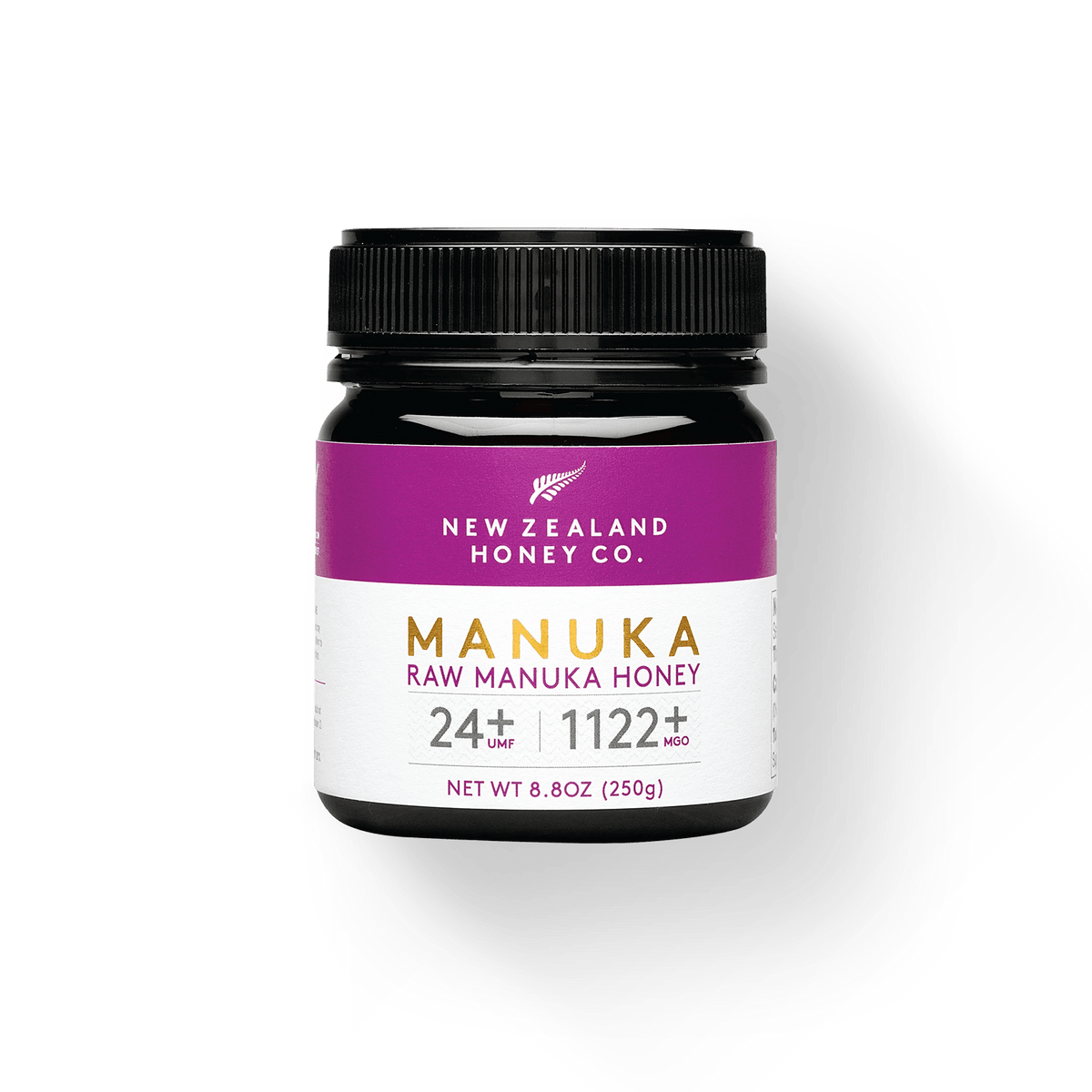
The Unique Manuka Factor Honey Association (UMF™) developed an independent grading system to help protect the integrity of genuine NZ Manuka honey.
The UMF™ grading system assures quality and authenticity. Only pure, raw, monofloral Manuka honey produced and packaged in New Zealand can receive this mark.
Each batch of certified honey is given a UMF™ grade according to the quantity of methylglyoxal (MGO) it contains. MGO is the key antibacterial compound associated with Manuka honey’s unique properties.
It’s a simple system: the higher the grade, the more MGO is present. The right grade for you all depends on what you want to use your honey for — which doesn’t have to just be oral care. (Here are over 170 ways you can use it.)
For everyday use, including as part of a healthy-mouth routine, the lower grades are great:
If you’d like a more potent option, opt for a higher grade:
If you want the very best that Manuka honey has to offer, choose from the highest grades available:
For more help choosing the right grade for you, take our free quiz!
Open Wide for New Zealand Honey Co. Manuka Honey
All our Manuka honeys are UMF™ graded, fully traceable, glyphosate-free, non-GMO, and packaged sustainably.
1 ingredient, 2000 natural compounds.
We only deal with real.
Your wellness journey starts with a spoonful a day.
SUBSCRIBE TO OUR NEWSLETTER
Receive our latest releases, offers, guides and more.
References
[2] Abu-Mostafa N, Al-Daghamin S, et al. "The influence of intra-alveolar application of honey versus Chlorhexidine rinse on the incidence of Alveolar Osteitis following molar teeth extraction. A randomized clinical parallel trial." Journal of Clinical and Experimental Dentistry. 2019. DOI: 10.4317/jced.55743
[3] Datta A, Mohanty S, et al. "Comparative Evaluation of Zinc Oxide Eugenol and Its Combination with Manuka Honey as Obturating Materials in Primary Molars: An In Vitro Study." Oral Sciences Reports. 2025. DOI: 10.12982/osr.2026.011
[6] Rahima AMG, Youness SB, et al. "Wound Healing Following the Use of Hyaluronic Acid and Honey for Multiple Extraction Sockets of Primary Teeth Compared to Saline in Children: A Randomized Clinical Trial." Egyptian Dental Journal. 2024. DOI: 10.21608/edj.2024.292608.3054
